
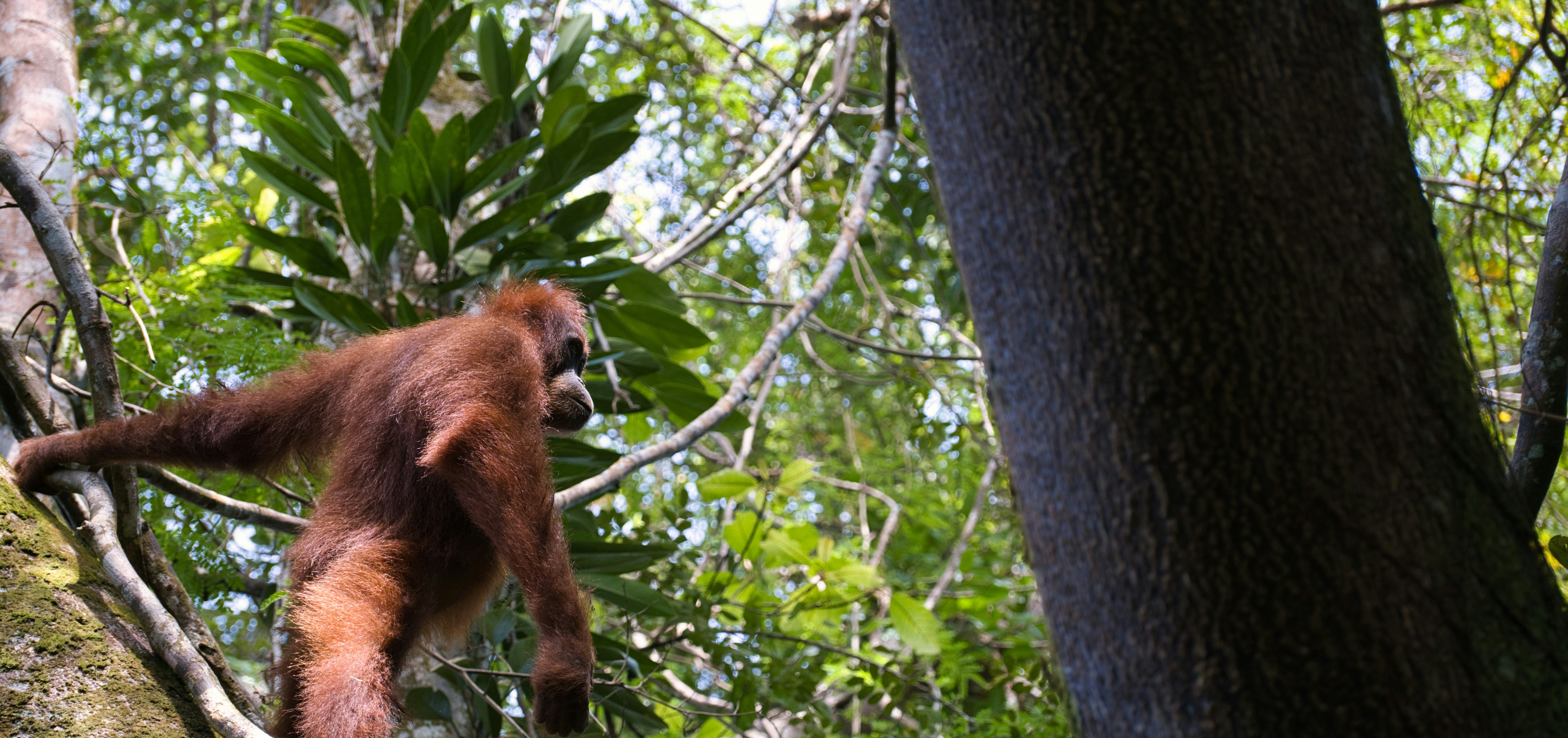
Orangutans of Leuser: A Forest Under Pressure
Introduction: A System at Risk
The Leuser Ecosystem in northern Sumatra is often described as one of the last great strongholds for wild orangutans. Covering more than 2.5 million hectares, it supports roughly 85 percent of the world’s remaining Sumatran orangutans while also harboring elephants, tigers, and rhinos. Yet despite its legal protections and global recognition, Leuser has become a focal point for understanding how conservation operates under sustained human pressure.
The central question is no longer whether orangutans can survive in pristine rainforest. Instead, it is whether conservation can stabilize a forest system that has already been cut, fragmented, and reshaped by roads, plantations, and fire.
The Leuser Ecosystem
Leuser is not a single forest type but a connected system spanning peat swamps, lowland rainforest, hill forest, and cloud-draped mountains. These zones are linked by rivers and elevation gradients that regulate water flow, carbon storage, and species movement. In intact conditions, this connectivity allowed wildlife to move across large areas in response to fruiting cycles, flooding, and seasonal variation.
For orangutans, the physical structure of the canopy is essential. As the largest arboreal mammals on Earth, they rely on tall, overlapping crowns and flexible branches to move, feed, and nest without descending to the ground. Continuous canopy cover functions as both habitat and highway.
Before Conservation: Roads and Fragmentation
Large-scale disruption began in the late twentieth century as industrial logging and plantation agriculture expanded across Sumatra. Lowland forests and peat swamps were the first to be cleared, often drained and burned to make way for oil palm and pulpwood plantations. Logging roads pushed deeper into previously inaccessible areas.
Researchers now identify roads as a primary driver of cascading forest loss. Once a road is established, it enables illegal logging, settlement, hunting, and further clearing. In Leuser, this process fragmented what had once been continuous forest into isolated patches.
As habitat shrank and fractured, orangutan populations declined sharply. Estimates suggest the Sumatran orangutan population has fallen by roughly half since 1980, with many surviving individuals now living in forests managed by timber, mining, or plantation companies rather than fully protected reserves.
Conservation Enters the Picture
Formal protection arrived after much of the damage had already occurred. Gunung Leuser National Park was established in 1980, and in 2004 the wider Leuser Ecosystem was designated a National Strategic Area due to its biodiversity and hydrological importance. On paper, these protections were strong. In practice, enforcement often lagged behind development.
Early conservation efforts focused on law enforcement: removing illegal plantations, stopping logging, and defending park boundaries. Legal challenges targeted companies operating inside protected areas, while advocacy campaigns pressured governments and international brands to restrict further expansion.
Over time, conservation strategies expanded beyond enforcement. Conflict response teams began relocating stranded orangutans from small forest fragments. Restoration projects aimed to replant degraded areas. Increasing attention was paid to maintaining connectivity between remaining forest blocks through corridors and riparian buffers.
Measuring Effectiveness
Assessing whether these efforts are working is complex. Some indicators are encouraging. In certain areas, deforestation rates have slowed compared to peak periods, and specific illegal operations have been shut down through sustained legal action. Conflict response teams have rescued and relocated hundreds of orangutans.
At the same time, these successes reveal structural limits. Each rescue reflects a landscape that can no longer support animals where they are found. Corridors remain narrow and vulnerable, and new infrastructure proposals continue to threaten connectivity.
Improved monitoring has clarified these dynamics. Line transect nest surveys, combined with satellite and drone imagery, show that orangutans can survive in selectively logged or degraded forest, but only where canopy structure remains sufficiently intact. Wide roads, drainage canals, and large monoculture blocks still act as effective barriers to movement and gene flow.
The Role of Climate Change
Climate change adds another layer of uncertainty. Altered rainfall patterns, increased fire risk in drained peatlands, and shifting vegetation zones complicate restoration and long-term planning. Conservation now operates against a moving baseline, where historical conditions may no longer be achievable.
Models suggest that continued habitat loss combined with climate pressures could push Sumatran orangutans below viable population thresholds within decades if current trends persist.
Evaluation and Outlook
Leuser demonstrates both the potential and the limits of modern conservation. Legal protections, monitoring technology, and targeted interventions can slow habitat loss and prevent immediate extinctions. However, these measures require constant maintenance and political support.
At a system level, success depends on scale. Protecting isolated patches is insufficient if roads and economic incentives continue to fragment the broader landscape. The long-term survival of orangutans in Leuser hinges on whether conservation can preserve large, connected forest systems capable of absorbing ongoing human and climatic pressures.
Conclusion
Conservation in Leuser is not a story of clear victory or failure. It is an ongoing negotiation between ecological limits and human demands. Orangutans can persist in altered forests, but only within bounds set by canopy structure, connectivity, and enforcement.
Whether Leuser remains a functioning ecosystem—or becomes a collection of managed fragments—will determine not just the fate of orangutans, but the resilience of the forest systems that support millions of people downstream.
Sources
- Re:wild. “Leuser Ecosystem Conservation.”
- Global Conservation. “Leuser Ecosystem, Sumatra, Indonesia.”
- Rainforest Action Network. “A Decade in the Leuser: A Model for Transformative Conservation.”
- Rainforest Action Network. “Orangutan Emergency: Fresh Evidence Exposes Illegal Deforestation for Palm Oil.”
- Public Policy Indonesia. “The Leuser Paradise: Orangutan Threats.”
- The Orangutan Project. “Forum Konservasi Leuser.”
- Wikipedia. “Leuser Ecosystem.”
- Wikipedia. “Sumatran Orangutan.”
- World Footprints. “Saving a Species: Palm Oil, Orangutans, and the Leuser Ecosystem.”
- CIFOR / Forests News. “Sumatran road plan could spell a dark new chapter for storied ecosystem.”
- Ancrenaz, M. et al. (2017). “Canopy structure drives orangutan habitat selection in disturbed and fragmented forests.” *PNAS*
- Thorpe, S.K.S. et al. (2009). “Orangutans employ unique strategies to control branch flexibility.” *Proceedings of the National Academy of Sciences / PMC*
- Orangutan Republik Foundation. “Groups welcome decline in deforestation in Indonesia’s Leuser Ecosystem.”
How this site works
We focus on verifiable outcomes and link to primary sources whenever possible. If you spot an error, we want to fix it.